
Home / Blog / How Do Flexi Dragons Move?
How Do Flexi Dragons Move? Print-in-Place Joints Explained
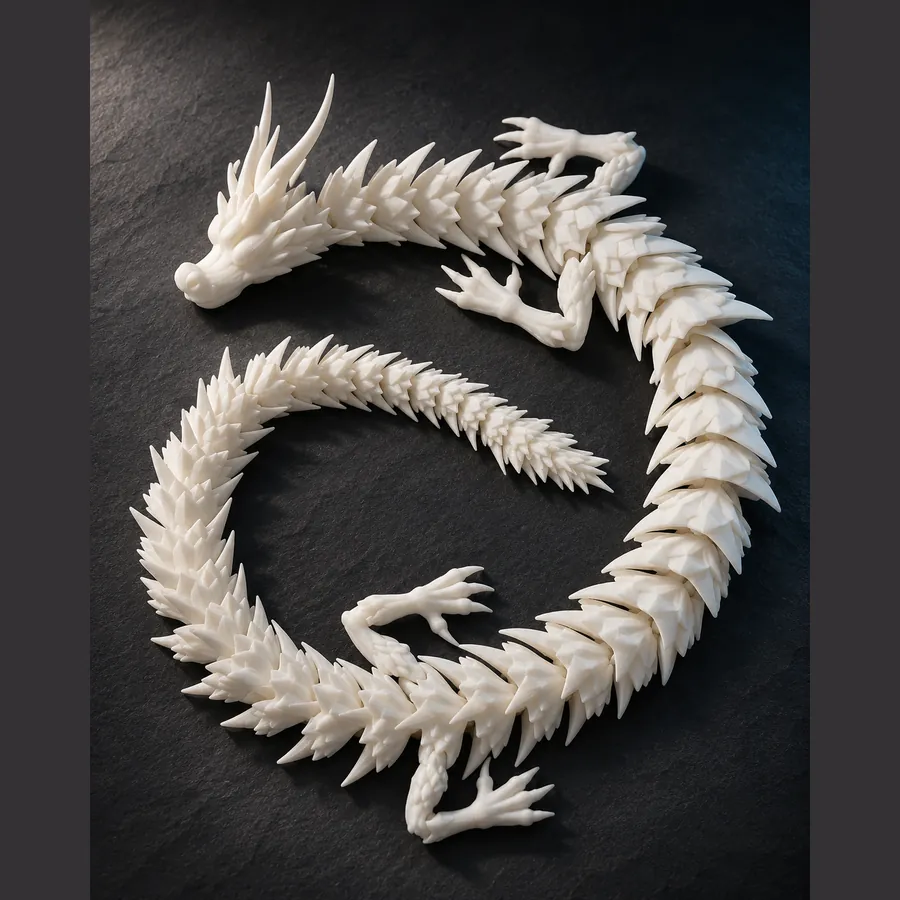
Flexi dragons move because every segment is printed already hooked into the next one, with a tiny gap between them so they can swing. There are no pins, springs or glue, and nobody snaps the pieces together afterward: the dragon comes off the printer in one piece, already bendy.
That's called print-in-place, and it's a neat trick once you see how it works. Here's what's going on inside the body, why each joint stops where it does, and how to keep yours moving smoothly.
What print-in-place means
A 3D printer builds an object one thin layer at a time, from the bottom up. Most prints are one solid lump of plastic. A print-in-place model is designed so that some parts never touch each other, even though they're printed side by side in the same job.
On a flexi dragon, the body is split into a chain of separate segments. Each one has a hook, peg or ring shape that sits inside the segment next to it. Because the printer leaves a small air gap around those shapes, the plastic never fuses together. When the print is done, you've got a chain of linked pieces that can't come apart, but can move.
Think of it like the links in a bracelet, except the links were made already joined instead of being opened and closed around each other.
The tiny gap that does all the work
The gap between parts is the whole secret. Designers usually leave a few tenths of a millimeter, about the thickness of a couple of sheets of paper. That's enough room for the parts to slide past each other, but small enough that the joint doesn't feel floppy.
Get the gap too small and the layers melt together, so the joint is stuck. Too big and the segments rattle around or droop. That's why a good flexi dragon depends on a well-made design and a printer that's tuned to print fine details accurately.
Why each joint only bends so far
If you bend a flexi dragon, you'll notice each joint swings a little and then stops. That's on purpose. The edges of each segment are shaped to bump into the next one at a set angle. The stops keep the body from folding back on itself and give it that smooth, snaky curve when you pose it.
It also tells you where the limit is. Once a joint stops, it's done. Pushing harder, or twisting a segment sideways, puts all the force on a thin bit of plastic, and that's how joints crack.
What moves on a flexi dragon
| Part | How it moves | Go easy on |
|---|---|---|
| Neck and head | Swings side to side and curls in a little | Pulling the head to straighten the body |
| Body segments | Each one bends a bit, so the whole body curls into a loop | Twisting a segment sideways |
| Tail | Curls and wiggles at the end of the chain | Using it as a handle |
| Legs | Move where they join the body | Bending a leg the way it doesn't go |
| Spikes, horns and claws | Don't move, they're part of each segment | Bending them at all |
Why it's printed in one piece
Our articulated dragon is printed in one piece, with spiky scales, horns and clawed legs that move. No assembly and no glue. That has a few nice side effects:
- Nothing to pop out. There are no pins, magnets or glued-on parts that can work loose.
- It works straight out of the box. You don't build it. You just start bending.
- It holds together as one body. The links are trapped inside each other, so the segments can't slide apart.
It also means the size you pick changes how it feels in your hand. The 4 inch keychain ($8) has the smallest segments, while the 16 inch ($35) has the biggest and is longer and heavier to move around. The 8 inch ($15) and 12 inch ($25) sit in between. Our flexi dragon size guide compares all four.
How to keep the joints moving
A print-in-place joint has no grease and no metal, so care is about not clogging or warping the gaps.
- Loosen it gently. If a joint feels snug at first, bend it slowly side to side a few times. Work from the neck to the tail.
- Never force a stuck joint. Wiggle, don't yank. Forcing it is how a segment snaps.
- Keep it cool. We print in PLA, a plant-based plastic that softens above about 55 °C (130 °F). Hot cars, sunny windowsills and dishwashers can warp the plastic and fuse the gaps.
- Keep the gaps clean. Dust, sand and crumbs can make joints gritty. Wash it by hand in warm soapy water, rinse well and let it air dry.
- Paint thin. Thick paint fills the gaps and glues the joints shut. Our guide to painting a 3D printed dragon shows how to paint one and keep it moving.
Quick answers
Are flexi dragons glued together?
No. A flexi dragon is printed in one piece with its joints already linked. There are no pins, glue or assembly. The segments come off the printer connected and ready to bend.
Why does a new flexi dragon feel a bit stiff?
A joint can feel snug the first few times you move it. Bend each segment gently side to side, from the neck to the tail, and it should loosen up. Never force a joint that won't move.
How far should a flexi dragon bend?
Each joint swings a set amount and then stops. That stop is part of the design. Bending past it, or twisting a segment, is how joints crack.
Can heat damage the joints?
Yes. Our dragons are printed in PLA, which softens above about 55 °C (130 °F). In a hot car or a dishwasher the plastic can warp and the joints can stick together.
Want one to bend for yourself? The articulated dragon is printed in one piece in four sizes, from the $8 keychain to the $35 16-inch. Add the DIY paint kit for $8 more and it arrives primed white, ready to paint.
Shop the articulated dragon